Storage for
Environments
That Cannot
Afford Failure
ASINE was founded as a spin-off of M-Systems — the company that invented Flash technology. For over 25 years, we have been engineering ruggedized storage for the programs where the question is not how fast, but whether it works when everything depends on it.
Came From
Flash memory was not invented in Silicon Valley. It was invented in Israel, by M-Systems — the company that created the DiskOnChip, the first solid-state drive architecture capable of replacing mechanical storage in embedded systems. ASINE was founded as a direct spinoff of that organization in 1999, inheriting not just the technology but the engineering culture: build for the environment, not the benchmark.
The flash storage market split early into two trajectories. One chased consumer volume — faster reads, lower cost, thinner margins, shorter lifecycles. The other served the programs where storage failure has consequences. ASINE took the second path and never left it.
Over 25 years, that choice has produced a customer base defined by the most demanding qualification regimes in the world: defense programs, aerospace platforms, orbital systems, industrial infrastructure operating continuously for decades without maintenance windows. These organizations do not ask for cheaper storage. They ask for storage that works — in the field, under full load, across the full lifecycle of systems specified once and required to perform for a decade or more.
the Same as
Predictable
The storage industry has spent thirty years optimizing for throughput and median latency. The result is hardware that performs brilliantly under ideal conditions and fails quietly under stress. Thermal throttling reduces performance without warning. Garbage collection storms introduce latency spikes measured in hundreds of milliseconds. Power interruptions during write cycles corrupt datasets. Components revised mid-program force requalification events that programs cannot absorb.
None of this is acceptable in the systems ASINE supplies. A satellite has a 90-second ground contact window. A mission computer in the field has no maintenance schedule. A defense platform operating in an extreme thermal environment cannot throttle its way through a difficult read cycle. The storage either works — completely, predictably, every time — or the mission is at risk.
ASINE products are engineered to that standard. Not as a marketing claim. As a verifiable property of the hardware: deterministic behavior under sustained load, hardware power-loss protection without supercapacitors, BOM freeze that guarantees the component qualified at program start is the component delivered at year fifteen.
The question is not whether your application can tolerate storage failure. It cannot. The question is whether your component selection reflects that.
Our customers — Rafael, Elbit, Toshiba, Mitsubishi Electric, Boeing, Airbus, Ramon Space — did not choose ASINE because we were the lowest-cost option. They chose ASINE because the programs were too important for the alternative. That is the only market we serve, and the only standard we engineer to.
Grade-A NANDs. Class-3 PCBs. Industrial-grade assemblies throughout. No consumer-grade components enter our supply chain. Western assembly only — no active components sourced from China. This is not a compliance checkbox. It is the foundation of the Configuration Freeze commitment that our programs depend on.
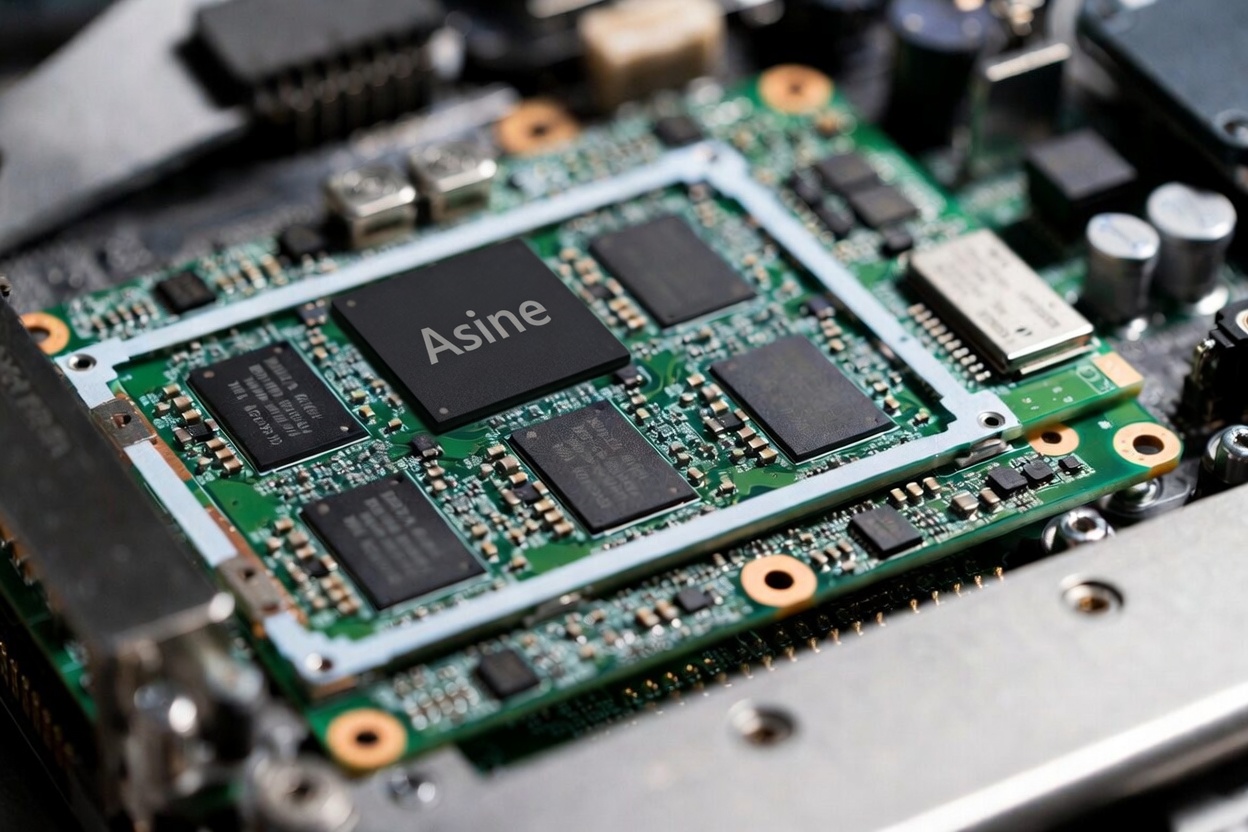
−50°C to +105°C operational range. Conduction cooling for sealed enclosures without forced airflow. MIL-STD-810H shock and vibration qualification. Conformal coating per MIL-STD processes. Built for platforms where thermal control is not an option.
AES-256 hardware encryption. TCG OPAL and FIPS compliance. Hardware-signal triggered secure erase — guaranteed completion in under 12 seconds. Power-loss protection without supercapacitors. Data security at the silicon level, not the firmware level.
NVMe Gen4 with consistent throughput under sustained load. No performance cliff at full capacity — a structural failure mode in TLC-based commercial drives. pSLC NAND for endurance without degradation. Predictable behavior when the mission depends on it.
BOM freeze policy. Twelve-month minimum PCN notification. Ten-year minimum availability commitment. Legacy products supported for 17+ years. Once ASINE is qualified into a program, the supply chain does not become the program's vulnerability.
You Can't
Outrun.
ASINE was built to answer yes — not as a benchmark claim, but as a verifiable, engineered property of the hardware. Twenty-five years of programs that could not afford failure. A customer base defined by the most demanding qualification regimes in the world. A supply chain built around the commitment that what you qualify is what you receive, unchanged, for the life of your program.
That is not a product feature. It is an architectural commitment — and it is the only thing ASINE has ever built toward.
Engineered for the Mission. Built to Endure.
Talk to an ASINE engineer about your application, qualification requirements, or lifecycle planning needs.